|
PHPCI Newsletter June 2024͏ ͏ ͏ ͏ ͏ ͏ ͏ ͏ ͏ ͏ ͏ ͏ ͏ ͏ ͏ ͏ ͏ ͏ ͏ ͏ ͏ ͏ ͏ ͏ ͏ ͏ ͏ ͏ ͏ ͏ ͏ ͏ ͏ ͏ ͏ ͏ ͏ ͏ ͏ ͏ ͏ ͏ ͏ ͏ ͏ ͏ ͏ ͏ ͏ ͏ ͏ ͏ ͏ ͏ ͏ ͏ ͏ ͏ ͏ ͏ ͏ ͏ ͏ ͏ ͏ ͏ ͏ ͏ ͏ ͏ ͏ ͏ ͏ ͏ ͏ ͏ ͏ ͏ ͏ ͏ ͏ ͏ ͏ ͏ ͏ ͏ ͏ ͏ ͏ ͏ ͏ ͏ ͏ ͏ ͏ ͏ ͏ ͏ ͏ ͏ ͏ ͏ ͏ ͏ ͏ ͏ ͏ ͏ ͏ ͏ ͏ ͏ ͏ ͏ ͏ ͏ ͏ ͏ ͏ ͏ ͏ ͏ ͏ ͏ ͏ ͏ ͏ ͏ ͏ ͏ ͏ ͏ ͏ ͏ ͏ ͏ ͏ ͏ ͏ ͏ ͏ ͏ ͏ ͏ ͏ ͏ ͏ ͏ ͏ ͏ ͏ ͏ ͏ ͏ ͏ ͏ ͏ ͏ ͏ ͏ ͏ ͏ ͏ ͏ ͏ ͏ ͏ ͏ ͏ ͏ ͏ ͏ ͏ ͏ ͏ ͏ ͏ ͏ ͏ ͏ ͏ ͏ ͏ ͏ ͏ ͏ ͏ ͏ ͏ ͏ ͏ ͏ ͏ ͏ ͏ ͏ ͏ ͏ ͏ ͏ ͏ ͏ ͏ ͏ ͏ ͏ ͏ ͏ ͏ ͏ ͏ ͏ ͏ ͏ ͏ ͏ ͏ ͏ ͏ ͏ ͏ ͏ ͏ ͏ ͏ ͏ ͏ ͏ ͏ ͏ ͏ ͏ ͏ ͏ ͏ ͏ ͏ ͏ ͏ ͏ ͏ ͏ ͏ ͏ ͏ ͏ ͏ ͏ ͏ ͏ ͏ ͏ ͏ ͏ ͏
|
PHPCI Newsletter | Issue 9 | June 2024 _______________________________________________________________ FROM THE PRESIDENT Dying, and saying goodbye, is a part of our lives, but we run away from it, we medicalise and professionalise it, like we do often with care in our society. Our society is actually not interested in dying, it's a taboo, and care giving institutions are not interested in care, they are mainly only interested in, and financed for, diagnostics and treatment of diseases. Recently, I have experienced it the hard way with the dying of my sister in a university hospital. My sister died June 3rd 2024 on an oncology ward of a so-called reference centre for cancer care. I encountered far too many diagnostics and far too much tunnel-vision focus on the treatment of the cancer, but far too little attention on giving care to my sister and support to her family, and some sort of professional palliative care was initiated less than 24h before she died. It was the family who was mainly responsible for the real care of my sister. Despite my being an expert in palliative care, I had to fight the doctors for days to get any form of palliative care in this so-called reference centre for cancer “care”. As a senior researcher in palliative care, I have to look into the mirror to some extent, because in our research, we have also looked at palliative care far too much and far too long from a medicalised model. Palliative care has been reduced to palliative medicine and that is a big problem; 80% of the problems in palliative care are not medical problems, but social, practical, emotional problems, and of the mental problems, only 10% need to be medicalised. For example, 90% of the emotional problems of loss and grief can be ameliorated by support from our partners, our family or friends, and there again this is often being medicalised. Most things in our lives we do just with the support of our social environment and that's what policy makers need to understand: dying is not about dealing with the care professionals, it's about living with our loved ones; they take care of the dying 24/7. Policy makers still don't understand that dying is a social experience with a medical component, and not a medical experience with a social component. Policy makers developed it from the mid-seventies into a medical experience, when we started to professionalise palliative care. It was reduced to a medical experience with a social component. If, at the end of the day, a social worker might be needed, we're going to add that too. But it should be just the opposite. We also know from studies that one in three people die suddenly and completely unexpectedly, two in three will consciously go through a process of disconnection, and we will have to rely on our closest family and friends, our partners or our children and grandchildren for day-to-day support in this process. In England, with Cicely Saunders, palliative care emerged as a counter-movement against the medicalised and aggressive treatment of cancer patients. The irony of the history of palliative care is that we have gone on to professionalise and medicalise palliative care and reduced it to palliative medicine. Therein lies the big problem. Policy makers on all levels still haven't understood that palliative care belongs to everyone; not only to the oncologist or the GP and even not to the palliative care doctor. Palliative care is about 'care' not 'treatment' and care comes from the social environment and people around us, our families, friends, neighbours, colleagues, etc. We need to make our society aware that it needs to take care of building social networks around dying people, around people with loss, grief and bereavement. Within public health palliative care we have a huge responsibility in building these supportive social environments, and as such improving the real caregiving. Our upcoming conference cannot come soon enough to continue the dialogue and the discussions on these topics. I am looking forward to our exciting PHPCI8 conference this year 22-25 October in Bern, Switzerland. On behalf of the PHPCI Council, I hope to see you all at our next world conference. Next to the science that will be presented at the conference, there will be place for the human, emotional and community building aspects of public health palliative care. The organising committee and the scientific committee have been working hard to prepare for you an exciting programme, a city programme and prior to the conference also a research oriented Public Health Palliative Care Academy. All of my best wishes,
|
|
Prof Luc Deliens MA PhD President of Public Health Palliative Care International |
|

|
|
|
|
_________________________________________________________________
|
Upcoming Events & Opportunities
|
Book now! Early Bird Registration Closing Soon.8th Public Health Palliative Care International Conference Bern, Switzerland.
|
|
The Public Health Palliative Care Conference 2024 (www.phpci2024.org), will take place between October 22nd and 25th 2024 at the beautiful Kornhausforum, City of Bern. Early bird registration is available until the 14th July, so be sure to register soon! You can explore the comprehensive conference program here. |
|

|
|
|
The conference and city festival are set to offer an amazing array of opportunities for learning and connection spanning four exciting days, featuring over 50 sessions that include insightful presentations, interactive workshops, enriching art and culture experiences, and much more. The biennial Public Health Palliative Care International conference will focus on highlighting and strengthening the value and importance of the end of life in science and society. Experts and interested professionals from around the world will discuss current and future research and education topics and their transfer to society as "compassionate cities." The conference has a diverse, multidisciplinary scientific program offering plenary lectures, seminars, and workshops designed by experts from various disciplines, including palliative care, public health, psychology, and sociology. This promotes a comprehensive and interdisciplinary exchange. In addition to the scientific conference, the city festival "ultimately.human" will take place from October 21st to 25th, 2024 and invites the population to engage creatively and openly with the topics of dying, death and mourning. This will create a platform for dialogue and personal encounters. The city festival will offer diverse interactive events including themed walks, productions, concerts, readings and art projects that encourage people to engage with the end of life. These events have been developed in cooperation with various renowned institutions and are aimed at a wide audience. Further information can be found at www.endlich-menschlich.ch. You can find out more about the fabulous conference events and program by visiting the PHPCI 2024 Conference Webpage (click here).
|
|
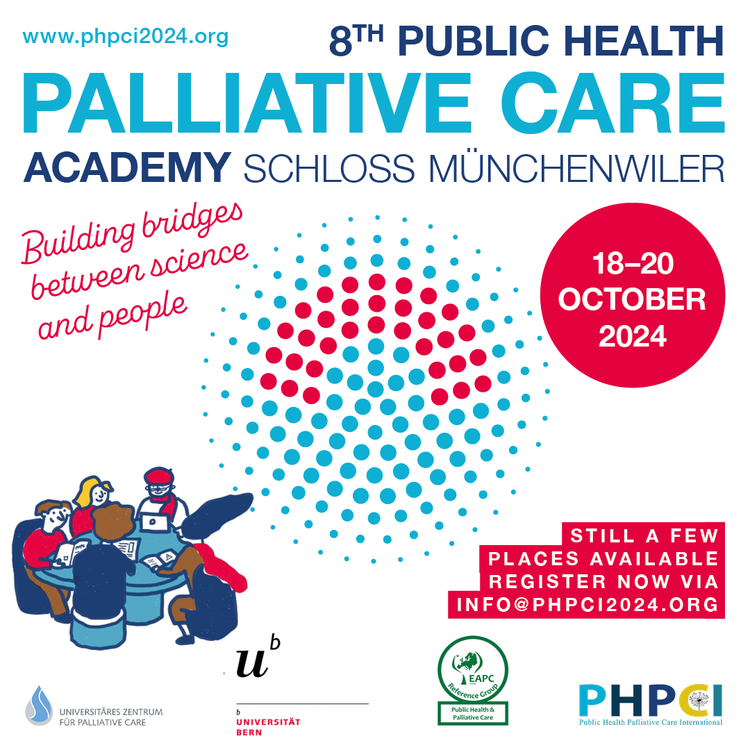
_________________________________________________________________ Public Health Palliative Care AcademyThe European Association for Palliative Care (EAPC) Reference Group on Public Health & Palliative Care will host the 2nd Public Health Palliative Care Academy between 18th – 20th of October 2024 in Münchenwiler, near Bern, Switzerland. The event will be hosted by University Center for Palliative Care, Bern, Switzerland. A few places remain available at this innovative educational event, so register now to secure your place. To register, please send an email to info@phpci2024.org.
|
|
|
The Academy will will bring together international experts and young scientists to collaborate on the advancement of research and educational topics in the field of public health and palliative care. The focus will be on innovation and the exchange of knowledge and experience. The program will provide a wide range of excellent learning opportunities including the chance to: |
|
|
|
Explore groundbreaking theoretical frameworks and concepts shaping public health palliative care with Luc Deliens (Belgium) and Libby Sallnow (UK). Uncover the transformative potential of community-based participatory action research with Carol Tishelman (UK) and Kelli Stajduhar (Canada). Navigate the intricacies of evaluating complex programs within public health palliative care with Valentina González-Jaramillo- (Switzerland) and Guy Peryer (UK). Examine the art and science of questionnaire and survey design with Joachim Cohen (Belgium) Therese Johansson (UK).
You can find out more information about the 2024 PHPCI Academy by clicking here. _________________________________________________________________
|
Public Health Palliative Care Webinar - Education & SchoolsThe 4th European Association of Palliative Care (EAPC) webinar will take place on October 7th 2024 (13h30 - 15h00 CET) and will focus on the role of schools and education in public health palliative care. The webinar will be chaired by Dr. Libby Sallnow. Keynote speakers will be Dr. Sally Paul (University of Strathclyde, Scotland) and Bert Quintiens (Vrije Universiteit Brussel, Belgium). The speakers will cover palliative care education for children and the presence of death and palliative care in the curriculum, and the development and activities of an international learning network on Compassionate Schools. Chaired by Libby Sallnow. The webinar program will include: • Sally Paul - Public health palliative care education: children and schools • Bert Quintiens - Learning network compassionate schools • Panel discussion and Q&A Don’t miss this event. Registration will open soon. Register by visiting the EAPC website or clicking here. _________________________________________________________________
|
Showcasing Public Health Palliative Care
|
|
Professor Sunjida Shahriah - Palliative Care Society of Bangladesh (PCSB) 1st April 2024! It's just another intolerable hot humid sunny day of month long dawn to dusk fasting of Ramadan in the largest slum in Dhaka, the capital city of Bangladesh. The climate change effect this year has turned this eighty acre area of tin-shed informal settlement almost into a burning furnace. Just imagine in the heart of the 7th largest and fastest-growing megacity of the world you will not see any tree, but only densely packed complete or incomplete housing units one encroaching another. This is the well-known as ‘Korail basti’, the Korail slum inhabiting a large somewhat diverse marginalized community of a developing country like Bangladesh. This is a country with per capita health expenditure of 43 USD in 2022 and out of pocket health expenditure is 63%, whereas about 1.8 million people live in informal settlements across the country. Asma, 38-years old, who suffered from carcinoma of the left breast with an open festering wound and metastasis, just died this morning here in Korail slum. Her husband decides to take the body back to her village for funeral. Neighbors whispered that ‘Asma was fortunate enough to be buried in the village’. She landed here few years ago being displaced from the village due to river erosion and always cherished the dream of returning, but could not manage. Her burial reminded one of Tagore’s song ‘let’s return to our roots’ because not all slum-dwellers could be buried in their villages.
|
|
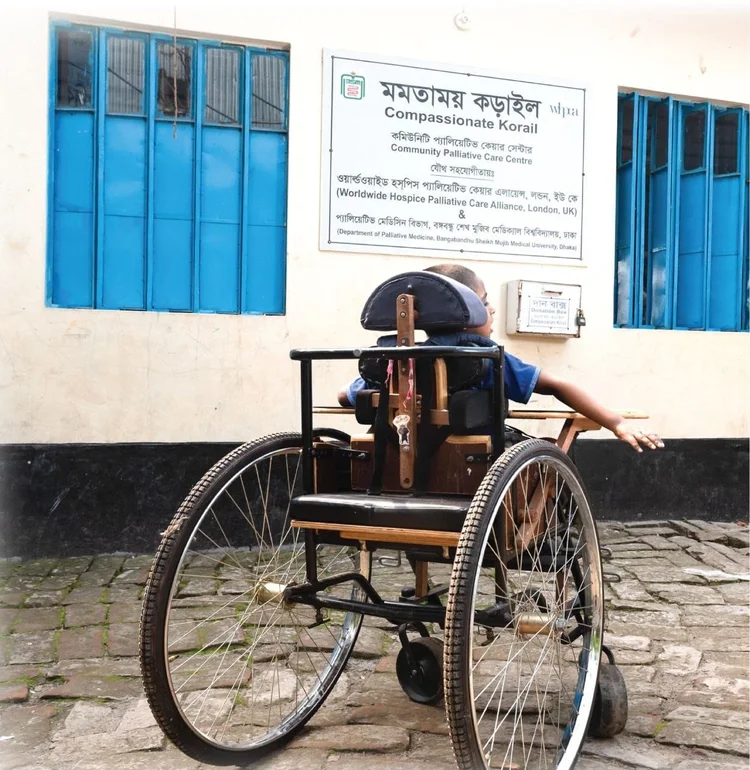
The Story of Asma Begum doesn't end here. As general medical care, palliative care does not end with the death of a patient, but rather support the grieving family. Asma, a registered patient of the ‘Momotamoy Korail’ (Compassionate Korail) project, can be mentioned in this regard. What happened next is better presented by our fieldworker, popularly known as ‘palliative care assistant’ Jahanra Akhter’s narration. Today, Asma’s husband visited our office. He held a religious memorial service for the deceased patient and brought sweets for us along with unused medicine. He thanked us for taking care of his wife and changing her dressing. He also said that we always responded when he had called us. He had never thought that we would be by her side like this. Imagine how it feels when someone after completing the burial rites of their loved one in the village, returns to the harsh reality of the Korail slum in Dhaka and yet does not forget to bring sweets as a gesture of gratitude! Looking back: Palliative care remained non-existent either by word or by philosophy in Bangladesh till 2007 when an activist initiated a rudimentary palliative care service in then the only medical university in the country. This group got exposed to basic palliative care training in the ‘institute of palliative medicine in Calicut, Kerala, India’. The same activist group, by then gradually grown into a larger group and had been successful in establishing a ‘Centre for Palliative Care’ in Bangabandhu Sheikh Mujib Medical University and initiated a community based palliative care program for elderly people in Korail slum in 2015. However, the Korail project was possible with a funding from the World Hospice Palliative Care Alliance (WHPCA) and is well known is known as ‘Compassionate Korail’. After its piloting for one year, the project ran smoothly for two more years and ended in 2019.
|
|
|
|
|
Then a major challenge appeared when the overseas funding stopped. Bangladesh had to decide if it would be able to continue the program of its own. The Palliative Care Society of Bangladesh (PCSB) decided to take over the responsibility of the project. PCSB is a registered charity formed in 2013 under the ministry of social welfare and had been supporting the university initiative. The compassionate Korail project has expanded to include children with incurable diseases alongside the elderly. At present it also runs a child day care/ respite care program named ‘Ananda’ (Happiness). Besides outpatient health care support including home care services, food packs, wheelchairs, burial expenses are often provided on a need basis. The project is also running ‘ASHA (Hope)’ charity shop where the used clothes and utensils collected from the civil society are sold on a nominal price. The slum dwellers maintaining their dignity decide the price to buy anything they want from this charity shop. The logic behind but rather the Eastern philosophy to maintain the dignity of the poorer. There is another program run by the society named ‘Showpno (Dream)’ which provides educational scholarships for students whose parents were registered marginalized patient |
|
|
|
|
Today still the sun is flooding with the highest heat wave in the last 75 years of Bangladesh. Even then Asma's story reminds us of Walt Whitman, "Keep your face always toward the sunshine - and shadows will fall behind you." Compassionate Korail teaches us many aspects of ground reality in the third world and we are convinced that palliative care needs to be re-explained and redefined in the context of third world where possible most of the world population lives. |
|
|
|
Together we can accomplish much more: Creation of a Palliative Care Regional Network for the CaribbeanDr Mark Stoltenberg, MD, MPH, MA Access to basic palliative care is a human right. The World Health Organization formally confirmed this in 2014 in WHA67.19 when it noted that providing basic palliative care services is an ethical mandate for healthcare systems worldwide. Despite this internationally recognized standard, access to palliative care remains extremely limited around the world—especially within the low- and middle-income countries where it is needed most. Like many other regions around the world, access to palliative care in the Caribbean is extremely heterogeneous. Within the public sector, Belize has a home-based palliative care service, the Cayman Islands has a public/private hospice unit, Jamaica has a combined oncology and palliative care unit, and Trinidad has a dedicated inpatient palliative care unit. Beyond these public services, several private clinicians also provide palliative care services across the Caribbean. However, even when combined, these public and private services only serve a small percentage of the population, meaning most Caribbean patients facing serious and life-threatening illnesses continue to suffer unnecessarily due to a lack of access to basic palliative care services. Palliative care leaders from across the Caribbean recognize the immense need for further expansion of palliative care services, and have been working hard for many years to expand clinical services and push political leaders to make palliative care a top priority. With support from the Pan-American Health Organization, a Project ECHO program was launched in 2020 to form a more cohesive community amongst these leaders. This interactive, free, and accessible-to-all education program involves a case discussion and didactic presentation of rotating palliative care topics, which takes place for 90 minutes on the second Tuesday of every month. This group continues to meet monthly and has helped to strengthen relationships and clinical collaborations between clinicians across the Caribbean (You can sign up here to join the group if interested). Though the Project ECHO group continues to meet monthly, it became apparent to multiple regional leaders that further structure was needed to accelerate collaborative work to increase access to basic palliative care across the region. Therefore, in collaboration with the WHO Palliative Care working group, a new regional collaborative network for the Caribbean was launched in February 2024. The mission of this group is to bring together palliative care leaders from the Caribbean, Canada, and the USA to identify shared objectives and work collaboratively to achieve these goals. These tasks include a broad array of activities aimed at the unifying goal of expanding access to palliative care in the region. Examples include advocacy for expanding national laws and policies, developing education programs, and creating and implementing clinical services. For each of these areas, the collaborative network seeks to partner groups that require a particular initiative with other groups that have already successfully implemented it so they can share resources and experiences. By sharing these best practices, this collaborative model seeks to decrease the time and effort members require to continue to expand their palliative care programs. The structure of this network is based upon one key principle: there is an immense need to expand palliative care in the Caribbean, and the most innovative and effective ways to meet this need are already scattered across the region. By combining the experience and expertise of palliative care leaders across the region, a suite of robust and culturally adapted palliative care models already exists. The vision for the network is that each member can share both their past achievements as well as where they still need to grow. It will only be through breaking down historical silos and fostering partnerships that go beyond borders that we may one day achieve our shared mission to provide access to basic palliative care services to every last patient across the Caribbean who needs it. _________________________________________________________________
|
Online Compassionate Communities Education Offering Launched in the USAElizabeth Johnson The public health palliative care approach, while increasingly recognized, has yet to achieve widespread traction in the United States. To foster informed dialogue and community-based action nationwide, The Peaceful Presence Project, a nonprofit organization from Oregon, has partnered with Dr. Karen Wyatt and Dr. Qwynn-Galloway Salazar to launch a free online education series. This initiative aims to inspire and support the development of compassionate communities across the country, enhancing quality of life, growing community-based competencies, and promoting civic forms of palliative care for individuals facing illness and grief, as well as their caregivers. The collaboration emerged after Elizabeth Johnson, a leadership council member for PHPCI, and Erin Collins, co-directors of The Peaceful Presence Project, were interviewed on Dr. Karen Wyatt’s podcast. The discussion focused on integrating the Compassionate Community model of care within their organization's mission and activities. One of their primary areas of focus is on developing more death and grief literacy within rural communities, addressing the unique barriers that these geographies face in terms of accessing quality and responsive end of life care. They emphasize the importance of engaging community members to care for one another in settings where formal palliative services are often unavailable. Around the same time, Dr. Qwynn Galloway-Salazar was also interviewed by Dr. Wyatt, highlighting her work in building compassionate communities for aging and ill veterans in urban centers in the southern US. As a hospice physician and author, Dr. Wyatt also became intrigued by the benefits of a public health palliative care approach and considered its application in her rural, high mountain town in Colorado. The group began to meet online regularly, sharing their experiences and efforts to implement the Compassionate Communities model in their respective areas.
|
|

|
What grew from the conversations was a desire to catalyze more interest and active adoption of the Compassionate Communities model of care within various geographies across the United States. |
|
|
|
Since being launched in early May, the aforementioned training has been taken by individuals from all walks of life, including healthcare professionals, community leaders, educators, and lay people interested in making a positive and unique impact to increase support for experiences of illness and bereavement. By participating, individuals gain valuable insights and practical skills to help cultivate compassionate communities in their own contexts. To participate in the free training or to learn more about this transformative initiative in the US, interested parties can visit compassionatecommunities.us _________________________________________________________________
|
PHPC Tools and Resources Updates
|
|
A collection of resources can be found on the PHPCI website, including toolkits, reports events, useful websites to name a few. Website: https://www.phpci.org/tools _________________________________________________________________
|
Launch of the Public Health Palliative Care International Compassionate Communities Endorsement ProgramThe primary community development work happening globally within public health palliative care is known as Compassionate Communities. In some countries, these initiatives are called Caring Communities. Public Health Palliative Care International (PHPCI) has developed the Compassionate Communities Endorsement program to continue supporting this community development work. This program will provide Compassionate Community initiatives with a PHPCI Compassionate Communities logo, which they can use to show their participation in the movement. The logo can be provided to local governments, workplaces, and other organizations that want to display it to show their involvement in the local initiative. By participating in the endorsement process, applicant communities will explore how to increase their community's support capacity. The PHPCI endorsement team will review the application data and share resources or knowledge to support the community's capacity-building goals. PHPCI's definition of a Compassionate Community has been adapted from the Canadian definition, co-developed by Pallium Canada, BC Centre for Palliative Care and Hospice Palliative Care Ontario. This definition states that a Compassionate Community is a collective of people who are working together to actively support those members who are caregiving, dealing with serious health issues, dying and/or grieving. These people are passionate about strengthening the capacity within their community to support those navigating these experiences. Based on this definition, cities, neighbourhoods, villages, workplaces, places of education, religious groups, online gaming communities, (and many more) are examples of where an initiative can occur. PHPCI recognises that each Compassionate Communities initiative may adopt unique approaches but that all Compassionate Communities embrace common guiding principles and features to guide their work. Hence, Compassionate Communities of all sizes and forms can participate in the endorsement process. The opportunity is intended for anyone who is working to increase their community's capacity to support members who are caregiving, experiencing a serious illness, dying and/or grieving. This capacity-building work can start small with a program and build into a community-wide initiative. PHPCIs will have three endorsement levels. Emerging - these initiatives are just beginning and are focused on creating awareness of the initiative through community and stakeholder engagement activities. Building - these initiatives are organized, raise awareness in the community, and actively engage the community in a program or event. Leading - these initiatives have existed for a few years, with strong community participation and programs or events showing a positive impact. Additionally, the initiative has a program or activity optimal for spreading and scaling within the community.
|
|

|
You can find out more about the PHPCI Compassionate Community registration process and submit an application for your compassionate community to be endorsed by clicking here. |
|
|
|
Webinar Recording: End-of-Life Care Research Group 7th COCO Seminar: Museums’ potential around serious illness, death and dyingIn May this year, the End-of-Life Research Group (Vrije Universiteit Brussel & Ghent University- Belgium) hosted an excellent Compassionate Communities Webinar on Museums’ potential around serious illness, death and dying. It featured four esteemed speakers who shared their insights from their practice and/or research on this topic:
|
|
Lieven de Visch who works for the museums in Bruges, Belgium Emel Yorganci and Annabel Farnood from King’s College London, UK Carol Tishelman from Karolinska Institute, Sweden
|
|

|
|
|
A recording of this seminar can be accessed by clicking here. _________________________________________________________________
|
PHPCI’s Journal - Palliative Care and Social Practice Attains its First Impact FactorProfessor Allan Kellehear, PhD, FAcSS In late 2017, I had several exchanges with academic and clinical colleagues that were having trouble with getting their papers published in topic areas within public health palliative care. One colleague reported that their article had been desk-rejected outright before review by a palliative care journal and others had reported a very difficult ride during the peer-review process. There was a feeling that if an article wasn’t health services research it wasn’t really understood or welcomed in some quarters of palliative care publishing. This is not surprising to me because the proposals for my own first two books on public health palliative care had received significant opposition. But that was twenty years ago or more. Although teaching at the University of Minnesota at the time, I opened discussions with SAGE UK management about the possibility of founding a new journal for our particular approach to palliative care. SAGE was receptive to these discussions. I argued that we needed a journal that would (1) champion the public health/health promotion approach to palliative care; (2) be led by senior members of the public health palliative care community and have a prominent editorial board made up of these colleagues, and (3) would be an editorial space for the intersections of a wide variety of social models of thinking and practice – public health, social sciences, social work, social policy, social criticism and cultural studies. The new journal would be co-edited by a physician and a member of PHPCI always. It would become the ‘official’ journal of PHPCI. The agreement was made in late 2018 and the journal was to be established from the remnants of an old, little-known journal then called Palliative Care: Research & Treatment. In 2019, we renamed and relaunched the new journal as Palliative Care & Social Practice with Prof. Lukas Radbruch and myself as editors-in-chief and with Prof. Luc Deliens and Prof. Denise Marshall as associate editors. We created a new and prominent editorial board from senior public health, social sciences, and social work colleagues and proceeded to market our presence at international conferences including our own. It was always my ambition to hold the reigns of the journal until we attained our first impact factor, showing colleagues everywhere that a public health journal in palliative care was not only viable and valued, but could be successful and widely sought after in palliative care research and publishing. In June this year, we received the news that our first official impact factor is 2.7. Palliative Care & Social Practice is ranked 60/174 in the “Health Care Sciences & Services” category, and 136/403 in “Public, Environmental & Occupational Health”. This means we are ranked in Q2 in both categories, placing us in the top half of all journals publishing in these categories. This is a brilliant outing for the journal, the outcome of some 5 years of hard work by our editorial team. I am proud to leave the journal to my successor Dr Libby Sallnow (University College London) who will now build upon this achievement for our field going into the future. Looking to submit to PHPCI’s has academic journal Palliative Care and Social Practice ? View the submission guidelines for details on the submission process, article processing charge and formatting your manuscript.
|
|
_________________________________________________________________ Recent PublicationsBrassolotto, J., & Banerjee, A. (2024). Age-Friendly Communities: Are they also “Friendly” for Death, Dying, Grief, and Bereavement? Canadian Journal on Aging. 43(2), 311–318. https://doi.org/10.1017/S0714980823000624 De Donder, L., Stegen, H., & Hoens, S. (2024). Caring neighbourhoods in Belgium: Lessons learned on the development, implementation and evaluation of 35 caring neighbourhood projects. Palliative Care and Social Practice. 18, 26323524241246533. https://doi.org/10.1177/26323524241246533 Leclerc-Loiselle J, Gendron S, Daneault S. (2024) Nursing activities for health promotion in palliative home care: an integrative review. Palliative Care and Social Practice. 18. doi:10.1177/26323524241235191 Mills, J., Abel, J., Kellehear, A., Noonan, K., Bollig, G., Grindod, A., Hamzah, E., & Haberecht, J. (2023). The role and contribution of compassionate communities. The Lancet (British Edition). https://doi.org/10.1016/S0140-6736(23)02269-9 Patel, M., Lewando Hundt, G., & Slowther, A. (2023). End-of-life care at home as a therapeutic landscape within a compassionate communities approach. Progress in Palliative Care. 31(6), 366–371. https://doi.org/10.1080/09699260.2023.2256176 Quintiens, B., Smets, T., Chambaere, K., Van Den Block, L., Deliens, L., & Cohen, J. (2024). Willingness to support neighbours practically or emotionally: A cross-sectional survey among the general public. Palliative Care and Social Practice. 18, 1–14. https://doi.org/10.1177/26323524241249196 Rosenberg J, Flynn T, Merollini K, Linn J, Nabukalu D, Davis C. (2024) Exploring the ‘citizen organization’: an evaluation of a regional Australian community-based palliative care service model. Palliative Care and Social Practice. 18. doi:10.1177/26323524241260427 Smith, S., Lowrie, D., & Dawes, N. (2024). Exploring the role of palliative care occupational therapists in supporting compassionate communities in end-of-life care. Australian Occupational Therapy Journal. https://doi.org/10.1111/1440-1630.12945 _________________________________________________________________
|
|
On behalf of the PHPCI council, we extend good wishes for the coming months, and we look forward to seeing many of you at upcoming PHPCI conference! Full members President - Prof Luc Deliens (Belgium). Vice President - Dr Kerrie Noonan (Australia) General Secretary - Bert Quintiens (Belgium). Treasurer - Dr Emma Hodges (UK). Membership Secretary - Bonnie Tompkins (Canada). General Member - Dr Daniel Lowrie (Australia). General Member - Dr Guy Peryer (UK). General Member - Dr Max Kleijberg (Sweden). General Member - Dr Esther Nafula (Kenya). General Member - Elizabeth Johnson (USA).
Ex officio members Journal Representative - Prof Allan Kellehear EAPC PHPC Representative - Dr Steven Vanderstichelen IAHPC Representative - Dr Natalie Greaves WHPCA Representative - Dr Stephen Connor Conference Representative - Prof Steffen Eychmüller
_________________________________________________________________ Social mediaFor questions and inquiries please visit our PHPCI website, by clicking here. For Facebook - click here For X - click here For Linkedin - click here _________________________________________________________________ Would you like to contribute to the PHPCI Newsletter?We would love to hear about your Public Health Palliative Care Project! Please send your experiences, stories, events or resources to be included in forthcoming Newsletters to Daniel Lowrie at daniel.lowrie@jcu.edu.au. We are also looking for regional partners to act as co-editors in assisting us in identifying and sourcing stories of public health palliative care initiatives that can be shared and celebrated in this newsletter. If you would like to take on this role, please get in touch with Daniel Lowrie, using the email address above. _______________________________________________________________ Editorial TeamDaniel Lowrie thanks the PHPCI Council for assistance with the development of this newsletter. Thank you also to all article contributors for sharing your resources, ideas and practice examples. _________________________________________________________________
|
|
|
|