|
PHPCI Newsletter July 2023͏ ͏ ͏ ͏ ͏ ͏ ͏ ͏ ͏ ͏ ͏ ͏ ͏ ͏ ͏ ͏ ͏ ͏ ͏ ͏ ͏ ͏ ͏ ͏ ͏ ͏ ͏ ͏ ͏ ͏ ͏ ͏ ͏ ͏ ͏ ͏ ͏ ͏ ͏ ͏ ͏ ͏ ͏ ͏ ͏ ͏ ͏ ͏ ͏ ͏ ͏ ͏ ͏ ͏ ͏ ͏ ͏ ͏ ͏ ͏ ͏ ͏ ͏ ͏ ͏ ͏ ͏ ͏ ͏ ͏ ͏ ͏ ͏ ͏ ͏ ͏ ͏ ͏ ͏ ͏ ͏ ͏ ͏ ͏ ͏ ͏ ͏ ͏ ͏ ͏ ͏ ͏ ͏ ͏ ͏ ͏ ͏ ͏ ͏ ͏ ͏ ͏ ͏ ͏ ͏ ͏ ͏ ͏ ͏ ͏ ͏ ͏ ͏ ͏ ͏ ͏ ͏ ͏ ͏ ͏ ͏ ͏ ͏ ͏ ͏ ͏ ͏ ͏ ͏ ͏ ͏ ͏ ͏ ͏ ͏ ͏ ͏ ͏ ͏ ͏ ͏ ͏ ͏ ͏ ͏ ͏ ͏ ͏ ͏ ͏ ͏ ͏ ͏ ͏ ͏ ͏ ͏ ͏ ͏ ͏ ͏ ͏ ͏ ͏ ͏ ͏ ͏ ͏ ͏ ͏ ͏ ͏ ͏ ͏ ͏ ͏ ͏ ͏ ͏ ͏ ͏ ͏ ͏ ͏ ͏ ͏ ͏ ͏ ͏ ͏ ͏ ͏ ͏ ͏ ͏ ͏ ͏ ͏ ͏ ͏ ͏ ͏ ͏ ͏ ͏ ͏ ͏ ͏ ͏ ͏ ͏ ͏ ͏ ͏ ͏ ͏ ͏ ͏ ͏ ͏ ͏ ͏ ͏ ͏ ͏ ͏ ͏ ͏ ͏ ͏ ͏ ͏ ͏ ͏ ͏ ͏ ͏ ͏ ͏ ͏ ͏ ͏ ͏ ͏ ͏ ͏ ͏ ͏ ͏ ͏ ͏ ͏ ͏ ͏ ͏
|
PHPCI Newsletter | Issue 7 | July 2023 _______________________________________________________________ FROM THE PRESIDENT Hello to all members and friends of PHPCI! Very soon, we will be opening nominations for Council positions as all elected roles come to the end of their terms. That process presents two opportunities. Firstly, for eligible current Council members to renominate and provide continuity in the governance of the Association; secondly, it invites PHPCI members to become instrumental in the life and work of the Association, bringing opportunities for vision and renewal. The call for nominations, an election if required, and our AGM to formally hand over roles are the key steps in this process and will be communicated shortly to PHPCI members. If you or someone you know are not members, there is time within the nomination period to become one in order to nominate. Please consider what you can bring to a leadership role and play a key role in PHPCI. More to come! Planning for this year’s World Compassionate Communities Day on 1st November is underway. This year, we are delighted to be working in partnership with the Worldwide Hospice Palliative Care Alliance who will kick off with World Hospice and Palliative Care Day on 14th October. With a focus on Compassionate Communities, these days bookend a period to showcase practice wisdom, growing knowledge and informative research; it informs the policy and social agenda local, nationally and globally. Please be alert for upcoming information about participation! Meanwhile, WHPCA has released its invaluable World Day Toolkit (in English) to enable individuals, local communities and organisations to contribute. Planning continues for the 8th PCHPI Conference in Bern, Switzerland next October. It promises to be another outstanding event, with a pre-conference PHPC Academy and a combined scientific and civic program. Very soon, PHPCI will be seeking potential hosts for the 9th PHPCI Conference in 2026 – our plan is to be in a position to announce the 2026 hosts and location at the 2024 Conference. Watch this space! As my own term as PHPCI President comes to a close, I look with great admiration at our global community and all it achieves in advancing PHPCI and its goal, to the greater benefit of our communities. I look forward to witnessing our Association’s ongoing impact. Best wishes,
|
|
_________________________________________________________________
|
Showcasing Public Health Palliative Care:
|
Compassionate community – Kenyatta National Hospital Project
|
|
|
Palliative care providers engaged in a three day compassionate communities workshop as part of the KNH Project |
|
|
Dr. Esther Nafaula - Palliative Care & Pain Management Specialist (Kenyatta National Hospital) Kenyatta National Hospital (KNH) is the largest referral hospital in East and Central Africa with a bed capacity of 2000. The Pain & Palliative Care Unit started offering services in 2007 and takes care of an average of 100 patients every week. Palliative care in Kenya still faces many challenges including lack of trained personnel, lack of budgets and late referrals to palliative care. The compassionate community project in KNH aims at improving advocacy for palliative care both in hospital and in the community. Compassionate communities are rooted in a health promotion approach to palliative care and encouraging end of life care within communities. In our Kenyan cultures, taking care of the sick and dying was done within communities and in the past cultures had ways of supporting such individuals and families. The culture evolved due to colonization, modernization, education and uptake of religion. Many individuals now live and work in urban centers. Local studies have found that many patients still prefer to die at home but this is often not possible due to perceptions within communities. It is perceived as neglect when a patient dies at home and other challenges such as lack of caregivers or living in rental houses also makes it difficult to honour wishes of the dying. Many individuals end up dying in hospitals surrounded by healthcare providers and medical machines. In some cases, families are able to provide end of life care at home. This is often challenging as the support needed from palliative care providers may be lacking. KNH serves patients from all over the country and region. Patients referred to palliative care sometimes need to be transitioned for home based care. The Compassionate KNH project has the objective of making it easier to having conversations about palliative care within the hospital staff and lay people in the community. The project is funded by a “Staff Innovation fund” that gives grants to support projects that will benefit patients within the facility. The pilot project will run in three phases namely: Training of caregivers, Developing of a Compassionate Community Starter Kit and Stakeholders meetings. A team of 10 palliative care providers within the hospital had a 3 day workshop and developed caregiver training manuals. The next step is to identify caregivers of patients needing palliative care at home (following discharge) who will be taken through a 2-day face-to-face training. The training will help them understand their patient needs and available resources to support them within their communities. The content that will be covered includes introduction to caregiving, introduction to palliative care, common symptoms, basic caregiving skills, spiritual issues, ethical issues, legal issues , death and bereavement; just to mention a few. The sessions will be interactive and will be led by a multi-disciplinary team. There will be two caregiver trainings monthly with each cohort having 15 participants. The trainees will be given their manuals to take home together with a list of palliative care providers around the country. The compassionate community champions will develop power point presentations and digital materials to be used during stakeholder meetings. The stakeholders will be identified among staff working in the hospital. They will have monthly meetings with the palliative care team to discuss key aspects of improving care within the community. The trained caregivers and stakeholders will complete periodic surveys for evaluation of the project. _________________________________________________________________ Podcast enables all to access palliative care adviceOtago Community Hospice last year produced a podcast built to help family carers when they have been thrown in the deep end caring for loved ones who are dying.
|
|
The podcast series - Ending Life Well – arose out of a frustration that people, throughout the large region of Otago, didn’t have equal access to the Kōwhai carers education programme despite best efforts. Palliative care nurse Denise van Aalst knew not all those family carers could make the Kōwhai sessions – due to timing, transport or fear of leaving their patient. She also knew the content she had to share was valuable. |
|

|
|
|
Otago Community Hospice had recognised in 2009 that although we spoke of caring for families as well as our palliative patients, we didn’t have a lot of focus on what their needs were. Dr Jennifer Angelo conducted a research project, using PhotoVoice, into what family carers wanted to know more about. What their priorities were, and what they felt they had struggled with. From that research the Kōwhai Programme was born.”- centralise resources, networking opportunities and dissemination of information on PHPC initiatives in national and international environments. Since then the programme has been running several times each year and has undergone regular evaluation and adaptation to meet changing needs. It covers a range of topics such as: Self Care for Carers, Legal Matters, Supportive Equipment and Moving & Transferring, Small and Tasty Meals, Learning About Loss, Advance Care Planning, Fatigue and Sleep, Medication Administration, What to Expect in the Last Days of Life, Finding Meaning, Breathlessness and Funeral Planning. “Kōwhai gathers family carers together to meet with others, and connect while gain information and they learn new skills. Of course, with the advent of Covid meeting face to face became problematic and so we went online via zoom. However while travelling to present the programme in a rural area I downloaded some palliative podcasts to listen to. One in particular was about family carers but when I listened to it, I was frustrated at the poor content and format. The next day I broached the idea of creating a localised podcast with the information we already had gathered for the Kōwhai programme.” Denise – with a small crew keen to innovate– started by researching what was available and was surprised that there was little to find. “While there was a great deal of palliative material, there was little, if any, aimed at the families caring for them. And there certainly didn’t appear to be anything in the Asia Pacific region. “So we set about recording our first topic. None of us knew anything about podcasts, or about recording so this was a big learning curve. But we knew the topics we already had were useful and were appreciated by those who attended Kōwhai. And from feedback we also knew the presenters we had were seen as engaging and warm. The intent was that these podcasts be conversational so they would be easy to listen to, and they needed to be short as so many family carers are already pressed for time. “We recorded two topics, the Importance of Self Care for Carers, and What to Expect at the End of Life. Thanks to a local experienced editor we were able to create a professional finish and we took these two topics and our plan to Hospice New Zealand who saw the value in this work and agreed to support the editing of the following 15 episodes.” Denise went on to record 17 episodes (to date), including two episodes of relaxation recordings that are effective for managing both breathlessness and busy brains that need some assistance to quieten and rest. Due to periods of being in lockdown here in New Zealand these were recorded over zoom. “An unexpected benefit of this was that nervous presenters tended to forget they were being recorded and were more relaxed,” says Denise. “After considering many complex recording options we discovered using the zoom format worked pretty well. We learned not to script it too far, but to trust the presenters we had as we already knew they were experienced and knowledgeable. And we found the transcripts created were easily adapted to be a record of the final podcast to improve access to these topics for the hearing impaired. “The podcast has proven to be a valuable resource for our community New Zealand-wide. Having the podcast available means that a key palliative and up-to-date resource is available to anybody, not just those on the hospice programme. And it is available at anywhere, anytime; so the right time for carers, on their terms not ours.” The podcast has been downloaded over 4000 times and from countries across the world. While created in New Zealand most of the content is relevant anywhere, especially across Australasia and the Pacific region.
|
|
Denise is now working on a second series which includes topics like Children and Grief, Transitioning to Aged Residential Care, The Importance of Touch and Intimacy, and The Challenges of Being a Carer and Tips for managing that. Always keen to have ideas and feedback, Denise believes this podcast will be a continually developing resource, building carers palliative skills wherever they are. Contact Denise van Aalst by clicking here. Access the podcast series by clicking here. |
|

|
|
|
_________________________________________________________________ Forever Garden: A serene space for healing, reflection, and community engagement
|
|
|
Opening of the Forever Garden in Townsville Australia (June 2023) |
|
|
Helene James -Community Development Officer (Townsville City Council) Townsville’s Belgian Gardens Cemetery has unveiled a ground-breaking addition to its grounds this June, with the grand opening of The Forever Garden. The Forever Garden space is the result of a collaborative effort between the Townsville City Council, Rotary of Townsville Saints, and the local community, showcasing the power of partnerships, the reimagining of cemeteries as public spaces, and the foundational role community development can play in creating compassionate communities. The Forever Garden has been designed for community members who have experienced the devastating loss of a child due to various circumstances, including miscarriage, stillbirth, childhood illness, or suicide. The space serves as a dedicated sanctuary where grieving parents and individuals can seek solace, reflect on their emotions, and cherish the memories of their beloved children. The thoughtfully curated space features installations garden beds, The Birdcage and Transcending Souls artwork created by artist Anna Mango and tranquil walking paths like The Pathway of Peace. These elements encourage visitors to pause, reflect on their emotions, and draw strength from shared experiences of grief. At the heart of the Forever Garden lies a profound understanding that grief is an essential part of the human experience. Ann-Maree Greaney, the chairperson of the Community and Cultural Development Committee, emphasises the importance of addressing grief within the community. "Grief can be an uncomfortable thing to talk about, but death, dying, and loss are part of life. As the cemetery's trustee, Council must take the lead and provide resources for members of our community who are grieving a loved one,” Cr Greaney said. The Forever Garden represents the culmination of a partnership journey grounded in trust and respect, which began in July 2019 when the Rotary Saints approached the Townsville City Council with the vision of creating a green park space to support grieving families. Rotary Club of Townsville Saints president Robin Strang said she was pleased to see the garden develop from an idea into a reality for the community. “What began as a thought and an email has flourished into a beautiful space, thanks to so many. A space to sit, take a breath, and help heal to learn to live again after loss,” Ms. Strang said. Rotary Saints maintain the garden beds and the garden is a central fundraising project for their organisation. The club will use money raised to assist with maintenance and work with Council to deliver grief and healing events within the space. Events will be provided at no cost to community and enable ways for people to build resilience, educate themselves on death and grief, and find solace in the company of others who have experienced similar losses. Regular visitors to the Belgian Gardens Cemetery can now find comfort in engaging with death and dying, enabling them to better support their families and communities through end-of-life experiences and grief. The Forever Garden stands as an inclusive and accessible green space that fosters public stewardship within the cemetery, serving as a poignant reminder that even amid death, life can flourish. By embracing grief, accepting the fragility of our existence, and recognising the enduring connection between life and death, the Forever Garden offers hope, healing, and a profound place of remembrance for the Townsville community.
|
|
The Forever Garden stands as an inclusive and accessible green space that fosters public stewardship within the cemetery, serving as a poignant reminder that even amid death, life can flourish. By embracing grief, accepting the fragility of our existence, and recognising the enduring connection between life and death, the Forever Garden offers hope, healing, and a profound place of remembrance for the Townsville community. |
|

|
|
|
_________________________________________________________________
|
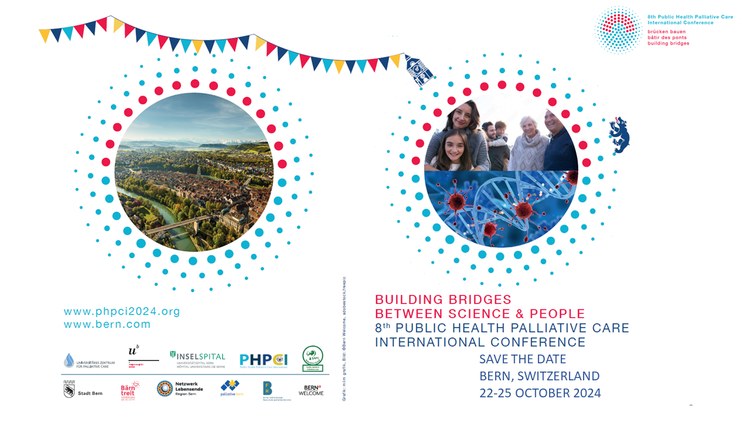
Save the date! 8th Public Health Palliative Care International Conference Bern, Switzerland
|
|
The 8th Public Health Palliative Care International Conference will be held in the city of Bern, Switzerland between 22nd and 25th October 2024. The conference is themed around building bridges between neighbourhoods and cities, regions and nations, health services and communities, and will serve as an opportunity to advance the philosophy, values, concepts and methods of health promotion into palliative care. Work on conference planning is well and truly underway. The committee for the city festival has had several meetings and the conference scientific committee held there first meeting in June. The scientific committee plan to send out a Call for Abstracts in August 2023, so watch this space! Other committees focusing on Compassionate Cities within German speaking countries and within Switzerland are currently being established, ensuring a unique a new and valuable dimension to the 2024 conference. Further information about the 8th Public Health Palliative Care International Conference can be accessed here.
|
|
_________________________________________________________________ International Collaborative for Best Care for the Dying Person - Annual SymposiumThe eighth Annual Symposium of the International Collaborative for Best Care for the Dying Person will take place in Rotterdam, The Netherlands, on 15th and 16th November 2023. Programme and registration information will be available soon. For more information about this upcoming event click here.
|
|
_________________________________________________________________ Public Health Palliative Care AcademyThe EAPC Reference Group on Public Health & Palliative Care will organize its 2nd Public Health Palliative Care Academy 18th – 20th of October 2024 near Bern, Switzerland. The event will be hosted by University Center for Palliative Care, Bern, Switzerland.
|
|
The Academy will bring together international leading experts in the field and a new generation of talented young researchers for an in-depth exploration of cutting-edge research in public health palliative care. Website: www.phpci2024.org Contact: info@phpci2024.org |
|

|
|
|
_________________________________________________________________ 3rd International Seminar on Public Health Research in Palliative CareThe 3rd International Seminar on Public Health Research in Palliative Care, organised in partnership with the European Association for Palliative Care Reference Group on Public Health and Palliative Care and All Ireland Institute of Hospice and Palliative Care (AIIHPC) will take place on 16th - 17th November 2023 in the Assembly Buildings, Belfast. The theme of the seminar ‘A Human Rights based approach to Palliative Care: Towards Solutions for Public Health Palliative Care’ is highly relevant as 2023 marks 75 years since the United Nations Declaration of Human Rights was proclaimed by the United Nationals General Assembly in Paris on 10 December 1948. Call for Abstracts now open Abstracts are invited which present research findings or methodological contributions under the Research Seminar themes below, Public Health Palliative Care Compassionate Communities Death and grief literacy Engaging and working with patients, informal caregivers and citizens to shape palliative and end of life care, caregiving and bereavement Collaborations between professional and non-professional caregivers Health promotion and palliative care Bereavement – End of Life care and bereavement care policies; public health interventions; bereavement literacy Population health models for palliative care Issues of equity and social inclusion in palliative and end of life care and bereavement Palliative care and underserved populations Community based approaches to palliative care The rights of patients and family carers
Please submit your abstract by Monday 31st August 2023. Visit The Palliative Hub for more information and updates. _________________________________________________________________ EAPC Webinar - Public Health Palliative Care: Evidence-BaseChair: Agnes van der Heide (Erasmus MC, The Netherlands) Speakers and topics: - Steven Vanderstichelen (End-of-Life Care Research Group Vrije Universiteit Brussel & Ghent University, Belgium) Complexities and Challenges in a Public Health Palliative Care Research - Joseph Sawyer (University College London, UK) The Evidence for the Effectiveness of a Public Health Palliative Care Approach More information: EAPCpublichealth@vub.be _________________________________________________________________
|
|
A collection of resources can be found on the PHPCI website, including toolkits, reports events, useful websites to name a few. Website: https://www.phpci.org/tools _________________________________________________________________ Recently Released Resources!
|
|

|
Podcast: End-of-Life university. Ep. 400 The Value of Death: The Lancet Commission Report with Dr. Libby Sallnow Dr Karen Wyatt (MD) interviews Dr. Libby Sallnow, a palliative medicine consultant and honorary senior lecturer at St. Christopher’s Hospice and the UCL Marie Curie Palliative Care Research Department, UK. Libby is also the co-author of The Lancet Commission Report on the Value of Death: Bringing Death Back Into Life. In this interview Karen and Libby explore the recent report from the Lancet Commission in the UK on the value of death and what each of us needs to do to help bring death back into life. To access this podcast episode click here. |
|
|
|
_________________________________________________________________ Website: Lancet Commission on the Value of Death This webpage can be used to register your interest in hearing more about events and resources relating to the Lancet Commission on the Value of Death. Links to previous webinars on this highly important topic are already accessible on this page. You can visit the Lancet Commission on the Value of Death webpage by clicking here. _________________________________________________________________ Film: Live the life you please Live the life you please is an uplifting portrait of the end-of-life. Palliative care is transforming the lives of Australians with life limiting illnesses, as one of the participants in the documentary says, “by openly acknowledging the reality of death, we’re better equipped to engage with life.” Live the life you please boasts a treasure trove of incredible stories captured all around Australia, from cities and regional centres to remote communities. It will make you smile, laugh, laugh harder and occasionally shed a tear as it shares the stories of a diverse range of Australians experiencing their last chapter. Their powerful stories will show you that palliative care is more than medicine. It’s about quality of life. It’s about providing physical, social, emotional and spiritual support to patients and their loved ones. It’s about embracing every moment and living the life you please until the very end. You can watch the trailer to the film here. If you would like to find out more about the film please contact the creators by clicking here. _________________________________________________________________
|
|

|
Digital Toolkit: World Hospice Palliative Care Alliance Compassionate Communities Together for Palliative Care Day World Hospice and Palliative Care Day is organised by the Worldwide Hospice Palliative Care Alliance, an international charitable organisation focusing exclusively on hospice and palliative care development worldwide with input from the global palliative care community and people with lived experience of palliative care. |
|
|
|
This year, on Saturday 14th October, World Hospice and Palliative Care Day will reflect a day of action in support of hospice and palliative care, with a particular focus on compassionate communities. This digital toolkit includes a wide range of valuable resources that have been developed by the Worldwide Hospice Palliative Care Alliance to support efforts to raise awareness and mobilise support for palliative care and compassionate communities from both governments and communities worldwide. The digital toolkit and array of resources within it can be sourced by clicking here. _________________________________________________________________ Evaluation Resource: Compassionate Communities Evaluation Guide The Evaluation Guide supports Compassionate Communities in measuring the impact of their initiatives, sharing learning outcomes and results, and facilitating discussions that translate knowledge into action. The Evaluation Guide was developed by the Pan-Canadian Compassionate Community Evaluation Project, a collaborative effort between BC Centre for Palliative Care, Hospice Palliative Care Ontario, and Pallium Canada. The Compassionate Communities Evaluation Guide empowers Compassionate Communities in their mission to improve experiences related to serious illness, caregiving, dying, and grieving. The Guide helps users evaluate an individual activity, a project or a program with their Compassionate Community initiative. Specifically, this guide will support users as they design their evaluation plan and data collection, providing a solid foundation for impactful, compassionate initiatives across Canada. A request to access the Compassionate Communities Evaluation Guide can be submitted by clicking here.
|
|
_________________________________________________________________ Recent PublicationsAll-Party Parliamentary Group Hospice and End of Life Care (2023). The Lasting Impact of COVID-19 on Death, Dying and Bereavement. London: APPG supported by Hospice UK. Available at: https://www.hospiceuk.org/publications-and-resources/lasting-impact-covid-19-death-dying-and-bereavement Bakelants, H., Vanderstichelen, S., Chambaere, K., Van Droogenbroeck, F., De Donder, L., Deliens, L., Dury, S., & Cohen, J. (2023). Researching Compassionate Communities: Identifying theoretical frameworks to evaluate the complex processes behind public health palliative care initiatives. Palliative Medicine, 37(2), 291–301. https://doi.org/10.1177/02692163221146589 Deliens, L. (2022). Cancer care, COVID-19 and dying in the 21st century. Palliative Care and Social Practice, 16, 26323524221141721–26323524221141721. https://doi.org/10.1177/26323524221141721 Dumont, K., Marcoux, I., Warren, É., Alem, F., Alvar, B., Ballu, G., Bostock, A., Cohen, S. R., Daneault, S., Dubé, V., Houle, J., Minyaoui, A., Rouly, G., Weil, D., Kellehear, A., & Boivin, A. (2022). How compassionate communities are implemented and evaluated in practice: a scoping review. BMC Palliative Care, 21(1), 1–131. https://doi.org/10.1186/s12904-022-01021-3 Jackson, T. (2023) The invisible heart: postgrowth economy as care. Centre for Understanding of Sustainable Prosperity. Available at: https://cusp.ac.uk/themes/aetw/blog-tj-invisible-heart/ Pettus, K., Connor, S., Downing, J., & Marston, J. (2023). Pandemic treaty should include provisions for palliative care. Bulletin of the World Health Organization, 101(6), 363–363A. https://doi.org/10.2471/BLT.23.289957 Pot, A. M., Rabheru, K., & Chew, M. (2023). Person-centred long-term care for older persons: a new Lancet Commission. The Lancet (British Edition), 401(10390), 1754–1755. https://doi.org/10.1016/S0140-6736(23)00920-0 World Health Organization (2023). Left behind in pain: extent and causes of global variations in access to morphine for medical use and actions to improve safe access. Geneva: World Health Organization. Licence: CC BY-NC-SA 3.0 IGO. Available at: https://apps.who.int/iris/bitstream/handle/10665/369294/9789240075269-eng.pdf _________________________________________________________________
|
Journal | Palliative Care and Social PracticePHPCI has its own academic journal Palliative Care and Social Practice The primary purpose of this peer-reviewed, open access journal is to raise the research and policy profile of a social model of palliative care. It encourages scholarly articles that challenge current discourse about the process of death, its current care models and practices, and of grief and bereavement. The journal welcomes articles from symptom science, clinical practice, and health services research. However, its aim is also to publish cutting-edge research from the realm of social practice - from public health theory and practice, social medicine, and social work, to social sciences related to dying and its care, as well as policy analysis, criticism, and cultural studies. The journal welcomes reports from work with under-represented groups, community development, and studies of civic engagement in end-of-life issues. The journal accepts a broad range of methodological designs – from trials to ethnography to analysis of existing sources. The journal is supported by an international editorial board and is a member of Committee on Publication Ethics (COPE). All articles are listed on PubMed, PMC and Scopus, and are freely available to read and download. Any general inquiries about the journal or about prospective submissions for our journal can be directed in the first instance to The Managing Editor, Georgia Patey – SAGE Publications Ltd, London, UK georgia.patey@sagepub.co.uk View the submission guidelines for details on the submission process, article processing charge and formatting your manuscript.
|
|
On behalf of the PHPCI council, we extend good wishes for the coming months, and we look forward to seeing many of you at upcoming PHPCI events! Full members President - Dr John Rosenberg (Australia). Term Ending 2023. Vice President - Dr Libby Sallnow (UK). Term ending 2023. General Secretary - Dr Vicki Jones (New Zealand). Term ending October 2023. Treasurer - Luke Conlon (UK). Term ending 2023. Membership Secretary - Bonnie Tompkins (Canada). Term ending October 2023. General Member (Webmaster) - Dr Kerrie Noonan (Australia). Term ending October 2023. General Member (Newsletter) - Dr Andrea Grindrod (Australia). Term ending October 2023. General Member (Research) - Dr Guy Peryer (UK). Term ending November 2024. General Member (Early Career Research) - Dr Daniel Lowrie (Australia). Term ending October 2023. General Member - Dr Zipporah Ali (Kenya). Term ending October 2023. General Member - Dr Eman Hassan (Canada). Term ending October 2023.
Ex officio members Journal Representative - Prof Allan Kellehear. Term ending October 2023. EAPC PHPC Representative - Prof Luc Deliens. Term ending November 2024. IAHPC Representative - Dr Katherine Pettus. Term ending November 2024. WHPCA Representative - Dr Stephen Connor. Term ending November 2024. Conference Representative - Prof Steffen Eychmüller. Term ending November 2024.
_________________________________________________________________ Social mediaFor questions and inquiries please visit our PHPCI website, by clicking here. For Facebook - click here For Twitter - click here For Linkedin - click here _________________________________________________________________ Would you like to contribute to the PHPCI Newsletter?We would love to hear about your Public Health Palliative Care Project! Please send your experiences, stories, events or resources to be included in forthcoming Newsletters to Daniel Lowrie at daniel.lowrie@jcu.edu.au. We are also looking for regional partners to act as co-editors in assisting us in identifying and sourcing stories of public health palliative care initiatives that can be shared and celebrated in this newsletter. If you would like to take on this role, please get in touch with Daniel Lowrie, using the email address above. _______________________________________________________________ Editorial TeamDr. Andrea Grindrod and Dr. Daniel Lowrie. Thank you to the PHPCI Council for assistance with the development of this newsletter. Thank you also to all article contributors for sharing your ideas and practice examples. _________________________________________________________________
|
|
|
|